10 Best Premed Post-Bacc Programs for Career Changers (2026-27)
Last updated September 2026
One of the most difficult aspects of comparing career changer postbacc programs is getting all of the information in one place. For all the non-traditional career changers out there, you are in luck. We’ve assembled a table of the best 10 premed post-bacc programs for career changers. That is, for individuals who have not yet taken most of their science coursework. We will let the table speak for itself. However, a couple of points to note about premed post-bacc programs.
How to Evaluate Premed Post-bacc Programs
Some of the major factors to consider when evaluating a program are program location, program size, student-to-advisor ratio, full-time v. part time, whether the program is integrated with undergraduate programs, linkages, and attrition rate.
Size vs. Student-to-advisor ratio
When selecting a program, the size of the program is important. Do you want to be in a class of 15 students? How about 30? 100? 500? However, this may seem more important than it actually is. In any large program you are likely to find a small group of friends, which will make the program feel smaller. What’s more crucial is the student-to-advisor ratio.
Full-time v. Part-time
In addition, program lengths vary. For Scripps, Hopkins, and Columbia, the variability is in large part whether the program is full-time or part-time as well as how much science coursework you have already taken.
Having the personalized attention of an advisor during the medical school application process is not to be underestimated. Fine-tuning your application and giving you personalized advice vastly increases your chances of getting into medical school.
Integration with Undergraduate Program?
Another big determining factor to consider is whether your post-bacc classes will also include undergraduates or not. For Hopkins and Columbia, it is especially important to note that you will be graded on a curve against (possibly crazy?) pre-med students.
Your quality of life will (most likely) be vastly better at smaller programs like Goucher, Bryn Mawr, or Scripps because those programs, even when integrated with undergraduate programs, are kinder grades-wise to the post-baccs. When applying to medical school, your GPA will likely matter a lot more than you think so it’s best to be at a kinder, easier program.
Linkages
One last point about the number of linkages. Having more linkages is a good thing if you are considering that option. However, not all linkage programs are created equal. While Columbia and Bryn Mawr may have a lot of linkages, you will want to dig deeper as to how many students successfully link each year. There are programs where very few of the linkage applicants successfully link, while other programs ensure a greater likelihood of success. Be sure to dig deeper into how often applicants are successful with these linkages!
Best 10 Premed Post-baccs:
With that in mind, here are Personal Premed‘s Rankings of the 10 top pre-med post-bacc programs (2026-27):
1. Bryn Mawr
2. Goucher
3. Scripps
4. Hopkins
5. George Washington
6. UVA
7. Georgetown University
8. Columbia
9. UPenn
10. NYU
| # | Program | Number of students | Program length | Class with undergrads? | Price | Number of linkages | Acceptance to DDS/DVM/MD | Attrition rate* (n) % |
|---|---|---|---|---|---|---|---|---|
| 1 | Bryn Mawr College | 65–70 | 12 months | Some | $$$ | 14 | 98% | (6) 9%* |
| 2 | Goucher College | 34 | 12 months | No | $$ | 8 | 98–99% | (1–2) 3–6%* |
| 3 | Scripps College | ~17 | 12 months | Yes | $$ | 3 | 98% | (1) 6%* |
| 4 | Johns Hopkins University | 25–30 | 9–14 months | Yes | $$$ | 7 | 99.7% | (3) 10%* |
| 5 | George Washington University | 35 | 12 months | No | $$$ | 4 | >90% | (1–2) 3–6%* |
| 6 | University of Virginia | 30–35 | 11–12 months | Some | $$ | 1 | 94–95% | 10–20%* |
| 7 | Georgetown University | ~35–45* | 15–24 months | Yes | $$$ | 5 | Undisclosed | 10–20%* |
| 8 | Columbia University | 400–500 | 1–5 years | Yes | $$$$ | 12 | ~90% | 10–20%* |
| 9 | Penn LPS (UPenn) | ~100* | 1–2 years | No | $$$ | 3 | 75% | 10–25%* |
| 10 | New York University | 40–100 | 18–24 months | Yes | $$$$ | 6 | 90% | 10–20%* |
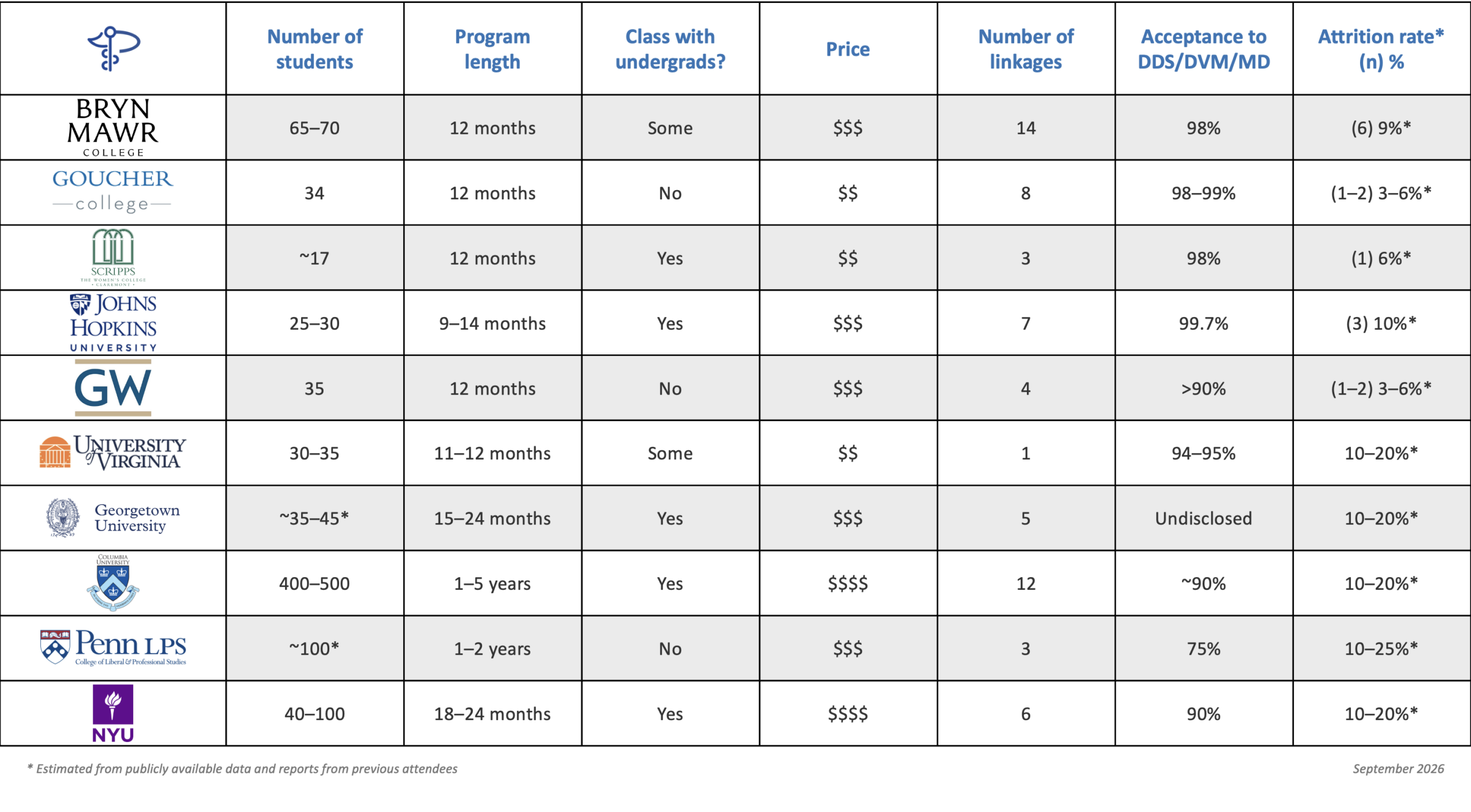
Methodology:
The bulk of this data was obtained from publicly available sources, especially program websites. Where noted with an asterisk, the data is anecdotal from previous program attendees, including from our former advisees.
Please keep in mind, this is a table written by two people who you probably do not know. Our preferences may not align with yours, so our #1 and your #1 postbac may be different programs. And for god’s sake, take everything you read on the internet with a grain of salt.
Frequently Asked Questions
What is the best postbac premed program for career changers?
Bryn Mawr and Goucher top our 2026 rankings. Both are 12-month programs built exclusively for career changers, with the strongest track records: 98%+ reported acceptance rates and the two largest medical school linkage networks (14 and 8 partner schools).
How much does a postbac premed program cost?
Tuition at top career-changer postbacs ranges from roughly $35,000 to over $100,000. Most programs in our top 10 fall in the $40,000 to $55,000 range for 2026-27, with NYU and Columbia at the high end.
What is a linkage agreement?
A linkage lets strong postbac students apply to a partner medical school early and skip the usual gap year between postbac and med school. Bryn Mawr has the largest linkage network in our top 10, with 14 partner schools.
How long does a postbac program take?
Most full-time career-changer postbacs take 12 months of coursework. Part-time options stretch from 2 years to as long as 5 at Columbia.
What acceptance rates do postbac programs report?
Top programs report medical school acceptance rates from 90% to over 99%. Compare carefully: programs measure differently, and some figures include dental and veterinary school or only count students who completed the full program.
Do postbac programs accept students who need to repair their GPA?
Mostly no. Nearly every program in our top 10 is for career changers with little or no science coursework. Students strengthening an existing premed record need record-enhancer programs, which are a different list.
How to Get In to a Top Premed Postbacs?
For more resources on how to get into the best premed postbac programs, be sure to check out:
- 5 Top Tips for Premed Postbac Personal Statements
- 13 Virtual Interview Tips
- 23 Medical Schools that Offer Merit Scholarships
If you like this content and would like more, sign up for our newsletter!